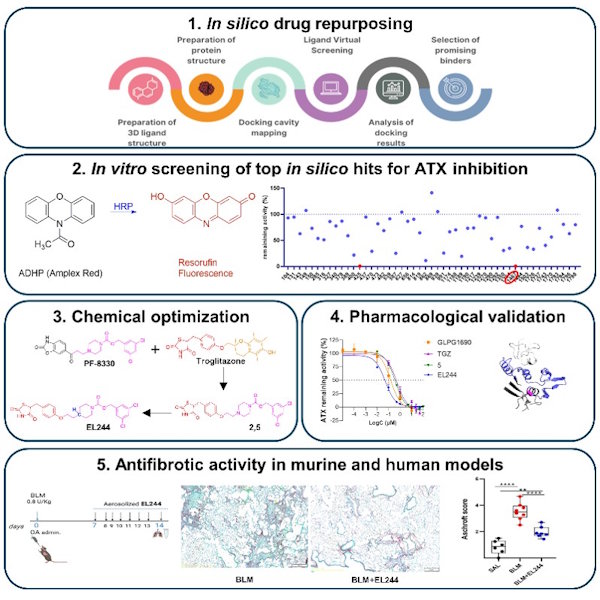
Idiopathic pulmonary fibrosis (IPF) is a fatal fibrotic interstitial lung disease (ILD) with limited therapeutic options. Autotaxin (ATX), an established drug target in IPF, is a secreted lysophospholipase D that catalyses the extracellular production of lysophosphatidic acid (LPA), a growth factor-like signalling phospholipid. The many pathologic effects of LPA in the lung include the co-suppression of peroxisome proliferator-activated receptor γ (PPARγ), a therapeutic target in metabolic disorders. In this report, we introduce EL244, a dual ATX inhibitor and PPARγ agonist endowed with drug-like properties. Developed through repositioning (1-2), rational design, targeted synthesis and pharmacological characterization (3-4), EL244 exhibited favourable efficacy and physicochemical profiles. Inhalation of EL244, which alleviates systemic toxicity concerns, attenuated bleomycin (BLM)-induced pulmonary fibrosis and restored respiratory functions; in translation, EL244 attenuated fibrosis in human fibrotic precision-cut lung slices (PCLS)(5). Therefore, EL244 emerges as a promising clinical candidate for the inhaled treatment of IPF and ILDs [PubMed].
EL244 exhibits the following unique competitive advantages:
• It exhibits favourable ADMET and PK/PD profiles, outperforming the previous ATX inhibitor in clinical trials.
• It possesses increased ATX inhibitory activity compared to the previous clinical candidate.
• It exhibits superior target engagement, never previously observed with any compound, as evidenced by HDX-MS and MS/MS lipidomics.
• It possesses PPARγ agonist activity, offering an unprecedented dual-targeting therapeutic advantage.
• It has a favourable toxicity profile.
• It is the first-in-class pharmaceutical agent dually targeting the underlying metabolic component of IPF.
• It is administered directly to the lung, minimising systemic safety concerns and avoiding drug-drug interactions.
• It was optimally shown to attenuate BLM-induced pulmonary fibrosis, including the assessment of respiratory functions, a readout better aligned to the human disease, increasing the translatability of findings.
• A superior PD biomarker, total LPA levels including all species, was associated with EL244, allowing efficient target engagement determination in future clinical trials.
The relevant national patent was awarded by the Greek Industrial Property Organisation (GR1010570). The corresponding filed PCT application for EL244 (WO2024134227A1), claiming priority from the national patent, has already received a positive International Preliminary Report on Patentability (IPRP) evaluation at the international preliminary examination stage and has entered the stage of the national/regional phases (Europe, USA, China, Japan, Mexico, Brazil, South Korea, and Eurasia). The extensive Fleming and Uni-Pharma IP portfolio on ATX has been licensed to DrugTrek, a micro small-to-medium enterprise (SME) and a Fleming and Uni-Pharma spinoff, founded in 2025. DrugTrek aims to advance the pre-clinical development of EL244 towards Investigational New Drug (IND) status, enabling phase I clinical trials.