ERC Proof of Concept Grant awarded to Dr Antigone Dimas to develop an actionable, decision support platform to predict LDL-C response to dietary restriction of animal products.
A new Proof of Concept grant from the prestigious European Research Council (ERC) will support the translation of cutting-edge multiomic and genetic research into an innovative decision support platform with the potential to advance precision prevention of cardiovascular disease.
Dr Antigone Dimas will take forward a technology developed through FastBio (Fasting Biology), an earlier ERC-funded research project. Known as LDL-ACT, the new project aims to commercialize a data-driven platform that predicts an individual's LDL cholesterol (LDL-C) response to dietary restriction of animal products. By integrating genetic, molecular, metabolic, microbiome, lifestyle, and clinical data, the platform will generate individualized predictions of LDL-C response, enabling more informed and evidence-based preventive care.
"Current prevention strategies largely assume that individuals respond similarly to dietary interventions, yet our research shows that biological responses vary substantially from person to person," Dr Dimas said. "LDL-ACT aims to harness multiomic and genetic data to predict an individual's LDL-C response before the intervention begins, providing actionable information that can support more effective clinical decision-making."
The platform will classify individuals according to their predicted LDL-C response, helping clinicians and individuals identify who is likely to achieve clinically meaningful benefit from dietary intervention and who may require alternative preventive strategies. By moving beyond conventional disease-risk prediction toward prediction of intervention response, LDL-ACT introduces a new approach to precision prevention that could improve clinical decision-making, increase the effectiveness of preventive interventions, and reduce unnecessary trial-and-error approaches.
LDL-ACT builds on discoveries from the ERC-funded FastBio study, which investigates the molecular effects of periodic dietary restriction of animal products using comprehensive multiomic profiling. The research has revealed widespread biological changes, including improvements in blood lipids and markers of liver and kidney health, a tempering of low-grade inflammation and shifts in immune cell composition, as well as changes in gut microbiome composition, while demonstrating that these responses differ markedly between individuals. Importantly, part of this variability is explained by genetic differences that influence how individuals respond to dietary intervention.
While initially developed to predict LDL-C response, the underlying framework is designed to be scalable and could be extended to additional biomarkers and health outcomes, creating a broader platform for predicting individual biological responses to preventive interventions.
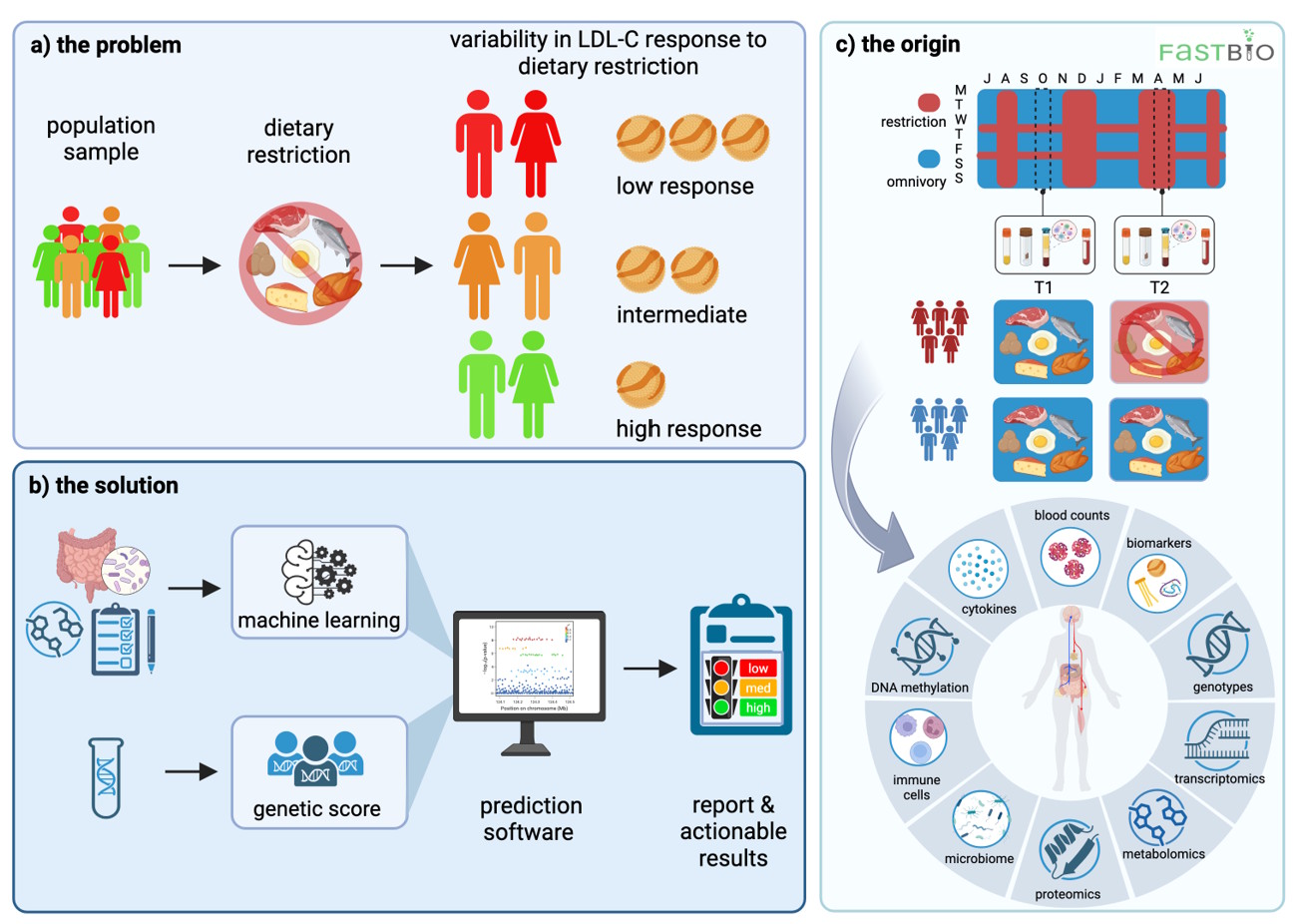
a) The problem: although animal product dietary restriction is widely recommended as a non-pharmacological intervention to lower LDL cholesterol (LDL-C) levels, there is extensive inter-individual variability in the magnitude of LDL-C response to dietary restriction. b) The solution: we will build a decision support platform that will predict LDL-C response by combining: i) a score generated through machine learning that will integrate anthropometric, biomarker, metabolic, microbiome and lifestyle parameters, and ii) a genetic score capturing diet-responsive effects. This will be combined with easy-to-use software and a structured interpretative report classifying individuals into response categories (high, medium, low) to create the prediction platform. c) The origin: the FastBio study explores the molecular impact of animal product restriction through an integrative, multi-omics approach and has uncovered widespread molecular reprogramming following dietary restriction as well as diet-dependent genetic effects.