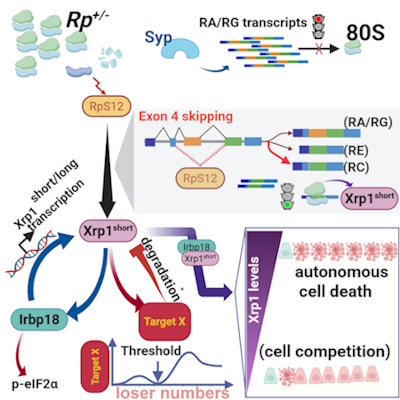
A new study from the Kiparaki lab reveals that RpS12-mediated induction of the Xrp1short isoform links ribosomal protein mutations to cell competition.
The universal phenomenon of cell competition refers to the context–dependent cell elimination via short-range cell–cell interactions. It was originally described in Drosophila, where heterozygous ribosomal protein (Rp+/−) mutant cells are outcompeted by their wild-type neighbors. The transcription factor Xrp1 has been shown to mediate most Rp+/− phenotypes, including reduced translation and competitiveness (reviewed in PMID: 37267156). Xrp1 also functions as a key stress sensor and effector in response to diverse stresses, and the RpS12–Xrp1 pathway coordinates inter-organ growth and eliminates certain aneuploid cells during development. Understanding how RpS12 activates Xrp1 is therefore critical for deciphering ribosome-linked homeostatic mechanisms.
In this study, splicing analysis -performed in a fantastic collaboration with Kafasla’s lab- together with genetic approaches, demonstrates that RpS12-dependent induction of the Xrp1short splice variant is the primary Rp+/− signal that defines loser identity and initiates cell competition. The authors further show that RpS12‑dependent induction and Syncrip‑mediated regulation of the Xrp1short isoform are sufficient to convert wild-type cells into losers.
Although the role of Xrp1 in cell competition is well established across different types of “loser” cells in Drosophila, it had remained unclear whether Xrp1 alone is sufficient to initiate this process. The authors now demonstrate that expression of either Xrp1short or Xrp1long isoform can trigger competition, establishing Xrp1 as a central driver of loser fate.
Unexpectedly, this study reveals that dynamic downregulation of Xrp1 is a central determinant of whether cells undergo cell death, engage in competition, or mount adaptive responses. The authors propose that adaptive downregulation of Xrp1 in loser cells resembles a quorum‑like response, in which both the number of loser cells and the identity of their neighbors determine whether the loser program is sustained or suppressed. This concept shifts the view that cell competition is a winner-driven elimination of losers, suggesting instead that loser status can be modulated by adaptive responses to the local environment, which may reduce stress and prevent elimination.
Human ribosomopathies combine tissue‑specific defects with cancer predisposition. Understanding how the Rp+/−-dependent Xrp1short‑driven loser program is initiated, amplified, and eventually attenuated may illuminate how ribosome‑linked stress responses contribute to early quality control and, when dysregulated, to clonal evolution and tumorigenesis.
Eleni Tsakiri*, Myrto Potiri*, Kyriaki Kontogiannidi*, Katerina Douka, Kiriaki Kanakousaki, Nikoleta Vavouraki, Maria Loizou, Panagiotis Moulos, Efthimios M.C. Skoulakis, Martina Samiotaki, Panagiota Kafasla, Marianthi Kiparaki#. RpS12-mediated induction of the Xrp1short isoform links ribosomal protein mutations to cell competition Cell Reports, available online 22 May 2026, https://doi.org/10.1016/j.celrep.2026.117380