Research by Sofia Papanikolaou from the Nikolaou lab identifies the early immune warning signs that signal the development of Systemic Lupus Erythematosus (SLE).
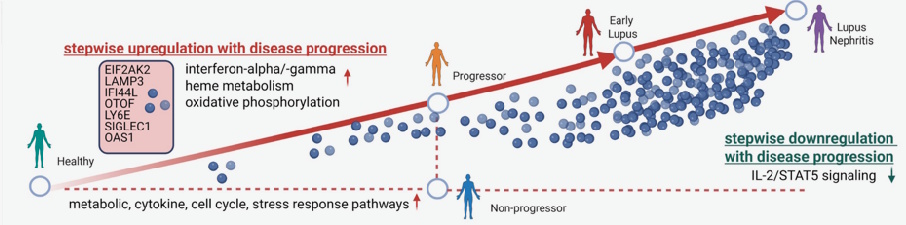
Lupus often starts with vague early symptoms before full disease develops, making it hard for physicians to predict who will get worse and start treatment in time. Research by Sofia Papanikolaou from the Nikolaou lab, in collaboration with the University of Crete, has mapped the molecular landscape of Systemic Lupus Erythematosus (SLE) progression from its earliest stages to severe disease. The study, published in Annals of the Rheumatic Diseases, reveals that individuals at risk for SLE—characterized by nonspecific symptoms or autoantibodies—already exhibit significant blood molecular deregulation involving metabolic, cytokine signaling, and stress-response pathways.
By utilizing blood RNA-sequencing across a multicenter cohort, the team identified that the transition from a preclinical "at-risk" state to classifiable SLE is specifically driven by the activation of type I and II interferon (IFN) and inflammatory cytokine pathways. The team developed a 17-gene susceptibility signature capable of predicting this transition with high accuracy in an independent validation group. The analysis further uncovered a "stepwise" amplification of these immune and metabolic signatures—including heme metabolism and oxidative phosphorylation—as patients move from health toward early SLE and severe manifestations like lupus nephritis.
These molecular disruptions are potentially reversible; in silico analyses demonstrated that existing biologics may counteract the programs driving disease evolution. These findings provide a vital roadmap for risk stratification, paving the way for early, targeted biological interventions to intercept SLE before it progresses to organ-threatening forms.
Sofia Papanikolaou, Evgenia Emmanouilidou, Christina Adamichou, Eleni Kalogiannaki, Dionysios Nikolopoulos, Micaela Fredi, Lucy Marie Carter, Chiara Tani, Noemin Kapsala, Argiro Repa, Nikos Malissovas, Panagiotis Garantziotis, Nestor Avgoustidis, Dimitra Nikoleri, Aggelos Banos, Giannis Vatsellas, Prodromos Sidiropoulos, Dimitrios Konstantopoulos, Dimitrios Boumpas, Edward M Vital, Laura Andreoli, Marta Mosca, Luís Inês, Christoforos Nikolaou & George Bertsias. Progression from at-risk state to clinical and severe systemic lupus erythematosus involves molecular dysregulations potentially reversible by biologics: implications for early diagnosis and treatment. Annals of the Rheumatic Diseases, (2026) (https://doi.org/10.1016/j.ard.2026.02.003)
Despoina Kosmara, Sofia Papanikolaou, Chrysoula Stathopoulou, Dionysios Papamatheakis, Giannis Vatsellas, Arianna Cimmarrusti, Aggelos Banos, Prodromos Sidiropoulos, Matthieu D. Lavigne, Panayotis Verginis, Dimitrios Boumpas, Charalampos Spilianakis, Dimitris Konstantopoulos, Christoforos Nikolaou & George Bertsias. The sex-biased chromatin modifier SMC1A promotes autoimmunity by shaping inflammatory pathways in patients with SLE. Nature Communications (2025). (https://doi.org/10.1038/s41467-025-65309-7)