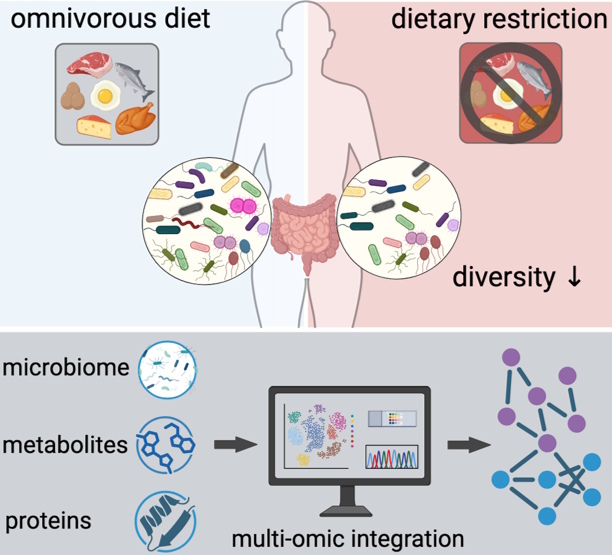
Research by Emmanouil et al from the Dimas lab reveals rapid and extensive remodelling of the human gut microbiome following short term dietary restriction of animal products, and uncovers associations with host molecular phenotypes.
Diet strongly influences the gut microbiome, which in turn influences health, yet the effects of dietary patterns on microbiome composition and function in humans remain underexplored. In this study Emmanouil et al focused on a unique group of individuals from Greece who alternate between omnivory and restriction of animal products for religious reasons. Using 16S rRNA sequencing, plasma metabolomics, and proteomics, the impact of three-to-four weeks of dietary restriction on gut microbiome composition and function was assessed and associations with host plasma biology were interrogated. Short-term restriction induced dynamic microbiome responses affecting one third of microbial taxa, resulting in a reduction of microbial diversity and in changes of predicted metabolic activity. Inferred functional shifts included downregulation of pathways contributing to cholesterol biosynthesis and purine degradation, alongside upregulation of vitamin B2 and tryptophan biosynthesis, suggesting compensatory microbial responses to dietary nutrient depletion. Multi-omics integration revealed microbial-metabolite-protein clusters, including a diet-responsive module associating Negativibacillus with metabolic regulator FGF21 and intermediate-density lipoproteins. These findings demonstrate rapid adaptive plasticity of the human gut microbiome in response to short-term dietary restriction, highlight diet-responsive bacterial taxa that may serve as candidates for further investigation for their role in health, and suggest associations with host physiology that can guide future mechanistic studies.
Christina Emmanouil, Maria Anezaki, Alexandros Simistiras, Stavros Glentis, Nikolaos Scarmeas, Pantelis Hatzis, Konstantinos Rouskas, Antigone S. Dimas. “Rapid Remodeling of the Human Gut Microbiome in Response to Short-Term Animal Product Restriction and Associations with Host Molecular Phenotypes”, Adv Sci (2026). https://doi.org/10.1002/advs.202515575
https://advanced.onlinelibrary.wiley.com/doi/10.1002/advs.202515575