Versican expression from lung fibroblasts suppresses pulmonary fibrosis
Fleming researchers have previously shown that TGF and the fibrotic ECM promote podosome formation in lung fibroblasts, thereby stimulating ECM invasion and pulmonary fibrosis. IPF fibroblasts presented with prominent podosome rosettes that could be retained ex vivo in the absence of any stimulation, suggesting podosome formation as an inherent property and a significant pathological attribute of IPF fibroblasts. [Nat Commun] Targeting podosomes and ECM invasion has been further suggested as a promising therapeutic approach. [Expert Opin Ther Targets]
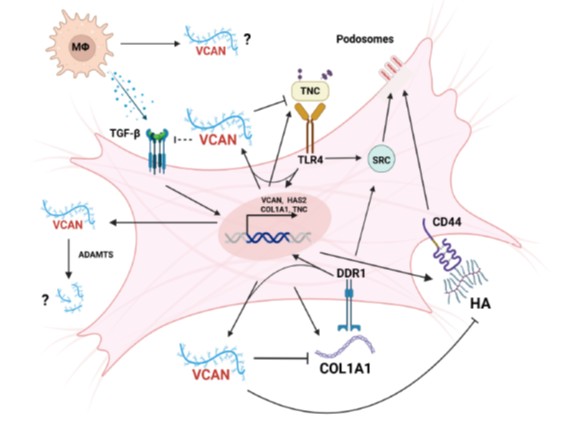
In this context, it was recently shown that TGF-β and a collagen-rich ECM promote Versican (Vcan), a multifunctional ECM proteoglycan, expression in fibroblasts, which reorganises the ECM, including the suppression of autologous collagen expression and polymerisation, HA synthesis, and Tnc secretion. The altered ECM, both in composition and structure, and the reduction of Tnc expression, suppress the autologous formation of TGF-β/collagen-induced, Src-mediated podosomes in fibroblasts and limit their ECM invasion and pulmonary fibrosis. [Nat Commun]
Understanding the regulation of fibrotic brakes, such as Vcan, will be essential to unravelling the mechanisms governing the resolution of fibrosis, the holy grail of fibrosis research, which will be instrumental in designing effective therapeutics. Moreover, and beyond the shown suppressive role of fibroblast-derived Vcan in autologous profibrotic functions, the overall effects of Vcan in the lung, which are dose-, cell-, and context-specific, remain to be further investigated. Notably, the pro-inflammatory, pathogenic role of macrophage-derived Vcan in pulmonary fibrosis warrants further study, fully supporting Vcan's name and its versatile functions and suggesting that, in fibrosis, Vcan can act as a “double-edged sword”.
A lay presentation of the article can be found at Clear Sky Science.